
Route optimization sounds simple at first: choose the shortest path, send the team out, and expect a better day.
Field operations are rarely that simple.
For service teams, installers, inspectors, delivery crews, field sales representatives, and mobile technicians, route optimization is really a way to control cost, capacity, and service quality at the same time. It affects how many stops fit into a shift, how much fuel gets burned, how often vehicles sit empty between jobs, and how reliably customers are served.
Official transportation guidance points to the same core value. Route and network optimization can reduce vehicle miles, fuel use, and emissions while improving the movement of people, goods, or service resources. In field operations, that turns routing from a dispatch task into a management system.
What route optimization means in field operations
In practical terms, route optimization is the process of planning and adjusting field routes so teams can complete the right work, in the right sequence, with the least waste.
That waste shows up in several forms: extra miles, idle time, poor territory handoffs, late arrivals, underused vehicles, and missed appointments. A route can look efficient on a map and still perform badly in the field if it ignores technician skills, appointment windows, traffic patterns, or the need to balance workload across a team.
This is why route optimization should not be treated as “fastest directions” alone. It is a decision framework. It weighs distance, time, fuel, labor, customer commitments, and operational constraints all at once.
EPA guidance on route and network optimization emphasizes exactly that broader value. The point is not just shorter travel. The point is fewer vehicle miles, better driver and equipment utilization, lower fuel consumption, and reduced emissions.
After that broader view is clear, the benefits become easier to see:
- Lower fuel use: fewer unnecessary miles and less idling
- Lower operating cost: less vehicle wear, less overtime, tighter use of labor hours
- Better service coverage: more stops completed in a day without simply extending shifts
- Stronger responsiveness: routes can change when weather, traffic, or customer requests shift
- Cleaner operations: reduced emissions through lower mileage and better dispatch logic
Why route optimization changes daily field operations
The biggest impact of route optimization is not on the map itself. It is on the shape of the workday.
A team with weak routing often starts the day behind. The first appointment may be too far from the depot. Midday gaps appear between jobs. One technician is overloaded while another has spare capacity. Dispatchers spend hours reworking schedules manually. Customers receive vague arrival windows because no one fully trusts the route plan.
A team with strong routing tends to work differently. Travel is more intentional. Territories are cleaner. Job sequences make sense. Dispatchers spend less time rescuing the plan and more time managing exceptions.
That difference compounds quickly over a week or month.
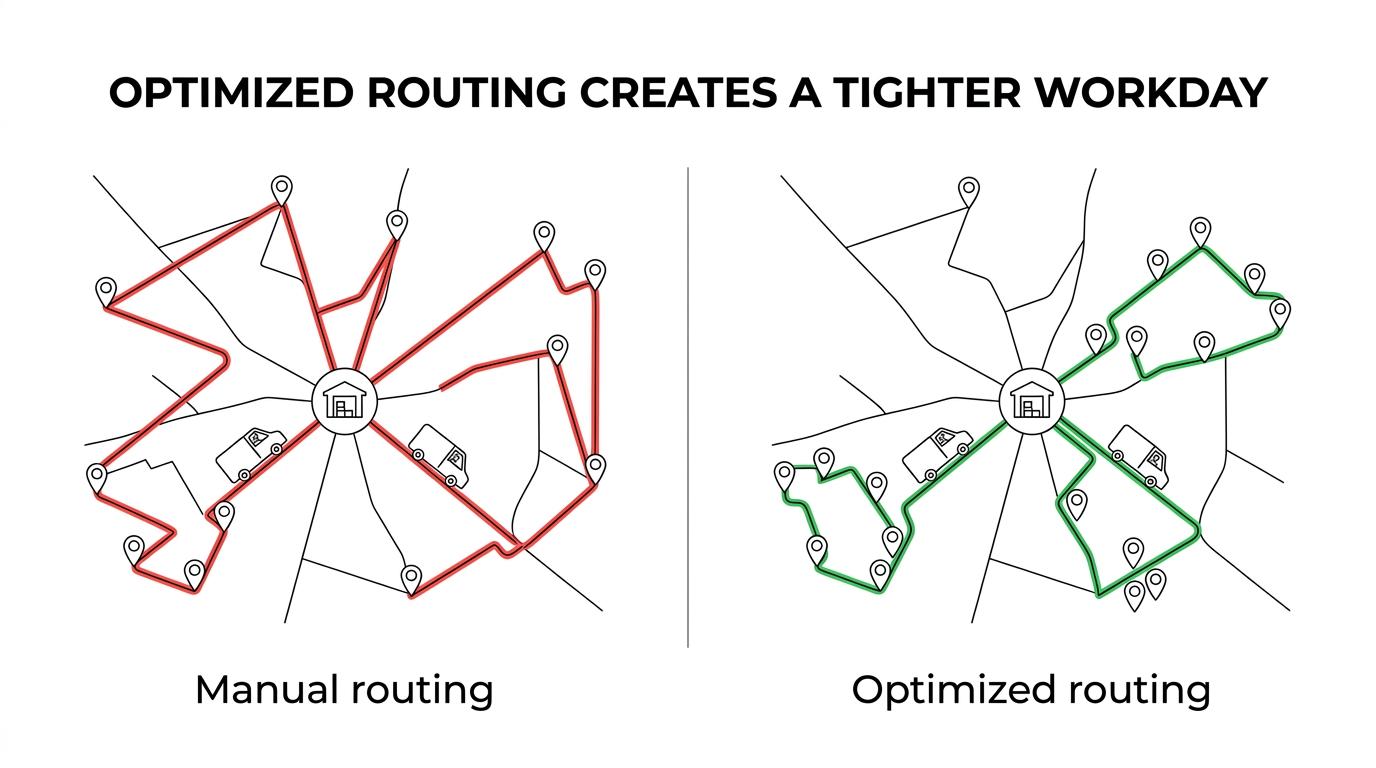
The Federal Highway Administration has highlighted large-scale route optimization examples that show this effect clearly. One well-known case, UPS’s ORION system, has been associated with major reductions in annual miles traveled, fuel use, and carbon emissions. While many field organizations operate on a much smaller scale, the principle carries over: small daily mileage savings become large operational gains when repeated across people, vehicles, and shifts.
Here is a simple way to compare the before and after:
| Area of operations | Manual or basic routing | Optimized field routing |
|---|---|---|
| Stop sequence | Often based on habit | Based on distance, time, and constraints |
| Dispatcher workload | High manual adjustment | More exception-focused |
| Fuel use | Higher due to detours and idle gaps | Lower through tighter sequencing |
| Capacity per day | Unpredictable | More consistent and measurable |
| Customer arrival windows | Broad and uncertain | Narrower and more reliable |
| Territory balance | Uneven | More controlled across the team |
| Reaction to change | Slow, phone-based | Faster, map-based reassignment |
Adaptive route optimization for changing field conditions
Static route plans break down fast.
Traffic builds. Weather turns. A customer cancels. A new urgent request appears. A technician calls out sick. Construction closes a road. The route that looked efficient at 8:00 a.m. may be the wrong route by 10:15.
That is where adaptive route optimization becomes important. FHWA has described adaptive routing as the ability to produce efficient routes in real time and in reaction to change. That matters for any field operation that lives with uncertainty, which is most of them.
A good field routing process should answer two questions at once: what is the best plan before the day starts, and what is the best adjustment once the day is in motion?
Those are different capabilities. Pre-planning helps with territory design, appointment sequencing, and staffing. Real-time adjustment helps with execution under pressure.
When teams bring those two together, they gain a stronger operating rhythm:
- plan the day with current constraints
- monitor field progress
- reassign work when conditions change
- capture the new route logic for future planning
This is one reason interactive mapping platforms matter so much in field operations. When route decisions live only in spreadsheets, texts, and phone calls, change is slow and confusing. When route decisions are visible on a shared interactive map, teams can respond faster and with less friction.
Route optimization metrics that matter beyond distance
Distance is only one metric, and often not the most useful one.
A route with low mileage can still fail if it creates poor stop order, violates service windows, or leaves a vehicle underloaded for half the day. Some official transportation sources use measures like loaded mileage proportion to compare how efficiently travel is being used. That framing is valuable because it shifts attention from movement alone to productive movement.
Field leaders usually get better results when they track a mix of cost, capacity, and service indicators rather than relying on miles alone.
A practical scorecard often includes:
- Vehicle miles: total daily or weekly travel by team, territory, or route
- Drive time: travel hours as a share of paid labor hours
- Stops per shift: productive capacity created by better sequencing
- On-time performance: arrivals made within promised windows
- Empty travel: time or distance between jobs that generates no service value
- Route changes: how often dispatch must override the original plan
- Fuel and emissions: operating and sustainability outcomes tied to route quality
This is where many teams make a useful shift in mindset. Route optimization is not just a planning feature. It becomes part of performance management.
Route optimization and service quality tradeoffs
Better routing does not automatically mean better service.
That point is easy to miss when mileage reduction becomes the main goal. Official reviews of transportation optimization efforts have shown that field-routing changes can improve trip efficiency while creating service tradeoffs if the redesign is too aggressive or if local realities are missed.
A recent example comes from a U.S. Postal Service Office of Inspector General review of Local Transportation Optimization. The initiative aimed to reduce transportation trips and increase how much mail was carried per trip. Yet the review found service performance declines and increased customer complaints about delays after implementation in the areas studied.
That does not mean route optimization is flawed. It means optimization needs the right objective function. If a routing model focuses too narrowly on mileage or trip consolidation, it can hurt time-sensitive service.
Field operations leaders should keep three ideas in balance:
- Cost control: fuel, labor, and asset use
- Service commitments: appointment windows, delivery promises, response times
- Operational resilience: the ability to recover when the plan meets reality
When route optimization works well, it respects all three.
What strong route optimization workflows include
Technology matters, but workflow design matters just as much.
A strong route optimization setup usually starts with clean location data, clear job definitions, and practical business rules. If customer addresses are inconsistent, service durations are guessed, and technician skills are not captured, even smart software will produce weak recommendations.
The next step is rule-setting. Teams need to define what “best route” means for their operation. That could mean fastest same-day service, highest stop density, least overtime, least fuel use, or a balanced mix. Without that clarity, route planning tends to swing between competing priorities.
The most durable workflows usually include the following pieces:
- Accurate map data: verified customer sites, depots, service zones, and road context
- Operational constraints: shift times, skills, vehicle type, break rules, and appointment windows
- Live visibility: route progress, missed stops, delays, and new requests
- Collaboration tools: shared access for dispatch, field staff, and managers
- Review cycles: compare planned routes with actual routes and refine the rules
One sentence matters here: optimization is never “set once and forget forever.”
Field operations change with seasonality, staffing, customer demand, and territory growth. Routes should be reviewed as living operating assets, not static templates.
Interactive mapping tools and route optimization execution
Route optimization becomes much more useful when teams can see it, edit it, and share it without relying on specialized technical staff.
That is one of the strongest reasons interactive mapping platforms have become part of field operations. A map-based workspace makes route logic visible. Teams can place jobs, assign territories, add notes, attach images or files, and share a current view of work across office and field staff.
For organizations that want more control without heavy technical overhead, no-code mapping tools can remove a major barrier. Managers and coordinators can build, adjust, and publish route-based workflows themselves instead of waiting for custom development.
In practice, interactive mapping supports route optimization in several ways:
- planning routes visually before dispatch
- comparing route options by territory or team
- tracking field progress on mobile devices
- capturing site-level notes for future visits
- sharing customer-facing or internal route views
- applying access controls for sensitive operational data
Platforms built for map-based operations can also support related tasks that strengthen routing quality, including field data collection, route planning, territory design, and operational analysis. That matters because route optimization rarely stands alone. It connects to scheduling, staffing, service history, and customer communication.
How field teams can start improving route optimization now
A full routing overhaul is not the only path forward.
Many teams can improve quickly by starting with one region, one crew type, or one service line. A pilot reveals where the real inefficiencies live. It also helps teams separate assumptions from measured results.
A smart rollout often starts with simple questions. Which jobs are routinely scheduled in the wrong sequence? Where are the largest empty-mile gaps? Which territories create overtime? Which customer windows are the hardest to meet? Which route changes happen repeatedly and why?
Those answers usually point to immediate opportunities:
- tighten territories
- reduce backtracking
- group nearby stops more effectively
- reserve capacity for urgent requests
- rebalance workloads across crews
- improve the quality of location and stop-duration data
The organizations that get the most from route optimization are rarely the ones with the fanciest dashboard. They are the ones that treat routing as an active operating discipline, measure what happens in the field, and adjust the plan with confidence.