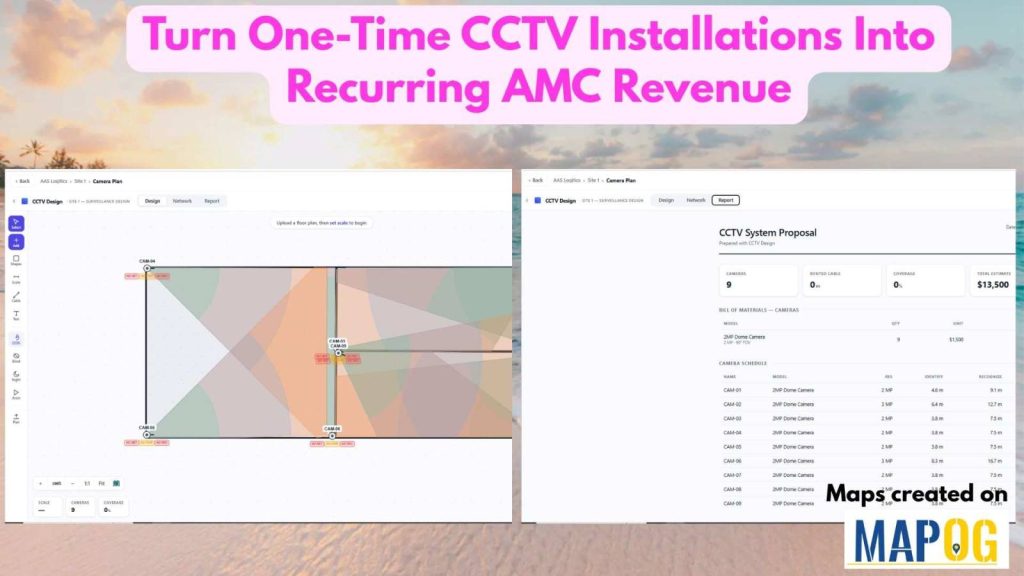
Every CCTV project starts with understanding the customer’s security requirements. But turning those requirements into a clear camera plan, professional CCTV Camera Planning Software, and accurate quotation can be challenging.
A verbal explanation may not be enough. Customers want to know where you will install the cameras, what areas they will cover, what equipment they need, and how much the complete solution will cost.
Without a visual camera plan, it can be difficult to explain the proposed CCTV system. A plain quotation may list cameras and equipment, but it does not show how those items fit into the actual security design.
MAPOG helps CCTV companies bring camera planning, CCTV design, and quotation generation into one connected workflow. Teams can place cameras on floor plans, visualize coverage, identify potential blind spots, add required equipment, and generate an itemized quotation based on the planned design.
The Challenge: Verbal Camera Plans and Separate Quotations
CCTV planning often begins with a site visit or customer discussion. The team identifies the areas that need monitoring and decides where to position the cameras.
However, when the customer receives only a plain quotation, they may not have a clear visual reference for the proposed installation.
This can lead to questions such as:
- Where will each camera be installed?
- Which areas will each camera cover?
- Are there any potential blind spots?
- What equipment is included?
- How does the quoted price relate to the planned CCTV design?
A visual camera plan helps answer these questions before installation begins.
Instead of asking customers to imagine the final setup, CCTV companies can show them the proposed system directly on the floor plan.
Design Layouts CCTV Camera Planning Software on Floor Plans
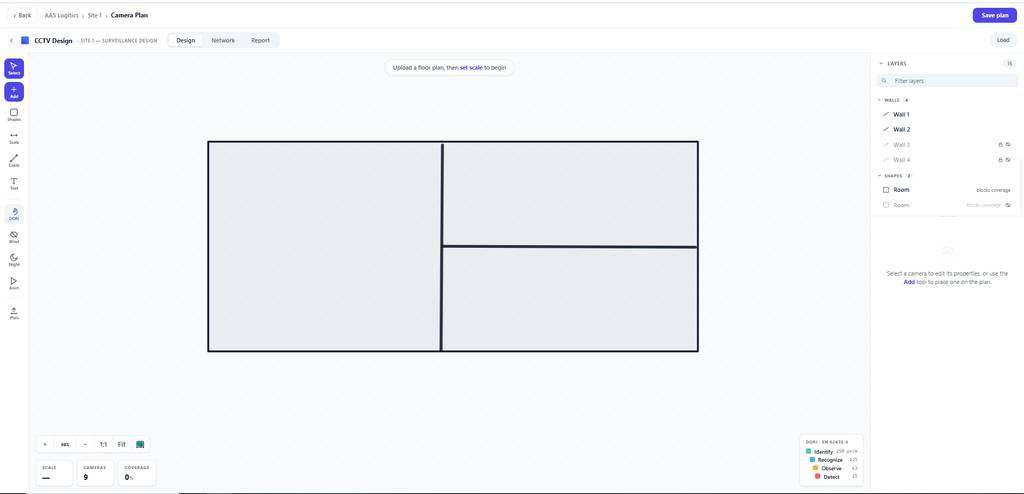
With MAPOG, CCTV teams can upload a building floor plan and start designing the CCTV system directly on it.
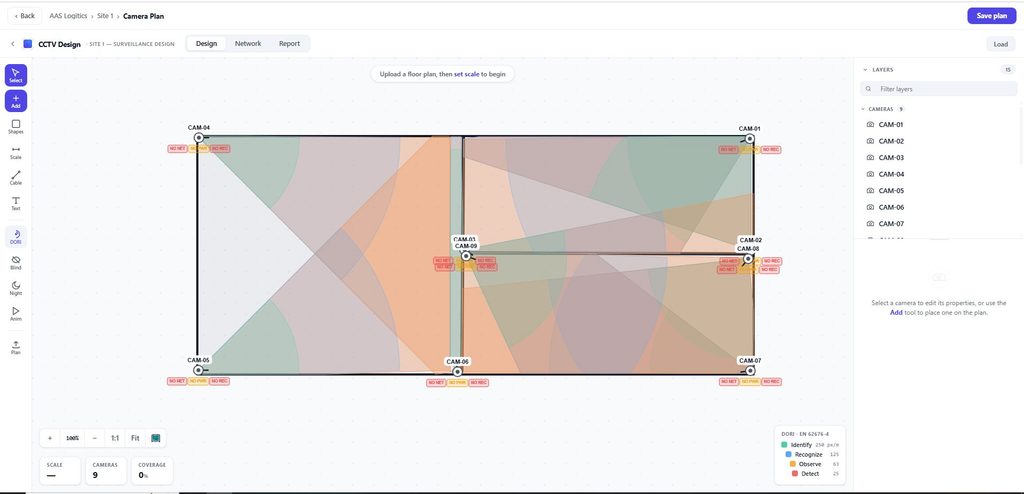
Each camera can be placed at its planned installation point. Teams can visualize the camera’s viewing direction, review the coverage area, identify potential blind spots, and verify DORI compliance before installation.
The design can also be customized with walls, rooms, markers, shapes, arrows, and text. Teams can add supporting equipment such as NVRs, PoE switches, routers, monitors, UPS systems, servers, speakers, alarms, and other required components.
This creates a detailed visual representation of the complete CCTV system rather than simply listing equipment in a quotation.
Read more: From Floor Plan to Quotation in Minutes — The Modern CCTV Planning Workflow
Check and Refine Camera Coverage
Camera placement plays an important role in effective surveillance. A camera positioned incorrectly can leave important areas outside the intended coverage.
With a visual CCTV design, teams can review the proposed coverage before installation and adjust camera positions when necessary.
They can check entrances, parking areas, reception spaces, warehouses, corridors, exit points, and other important locations to make sure the planned system meets the customer’s requirements.
You can refine the CCTV design before installation instead of discovering coverage issues after installing the cameras.
Generate Itemized CCTV Quotations
Once the camera design is ready, the next step is presenting the project cost.
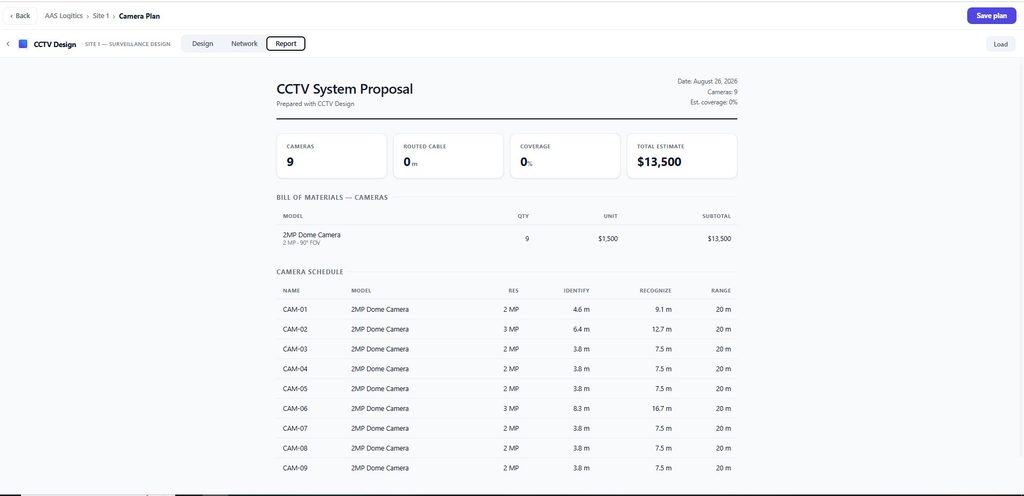
MAPOG connects the planned CCTV design with quotation generation, helping teams create an itemized proposal based on the required equipment.
The quotation can show details such as camera model, quantity, unit price, subtotal, and total estimated cost.
Customers can also review camera-related specifications such as resolution, identification distance, recognition distance, and coverage range.
The proposal can include a detailed Bill of Materials, covering cameras, NVRs, PoE switches, storage devices, cabling, accessories, and other required components.
This gives customers a clearer understanding of both the proposed CCTV system and its cost.
Keep the Camera Plan CCTV Camera Planning Software and Quotation Connected
The biggest advantage is that the camera plan and quotation do not have to be managed separately.
When the CCTV design changes, the quotation can change along with it.
For example, if you add another camera to the floor plan, the quotation automatically reflects the updated quantity and cost. If you remove a camera or change the equipment in the design, you can adjust the quotation accordingly.
This keeps the camera layout, equipment requirements, Bill of Materials, and pricing aligned.
Your team doesn’t have to manually update multiple spreadsheets or recalculate the quotation every time the design changes.
The customer can therefore review a proposal where the planned CCTV system and its pricing remain connected.
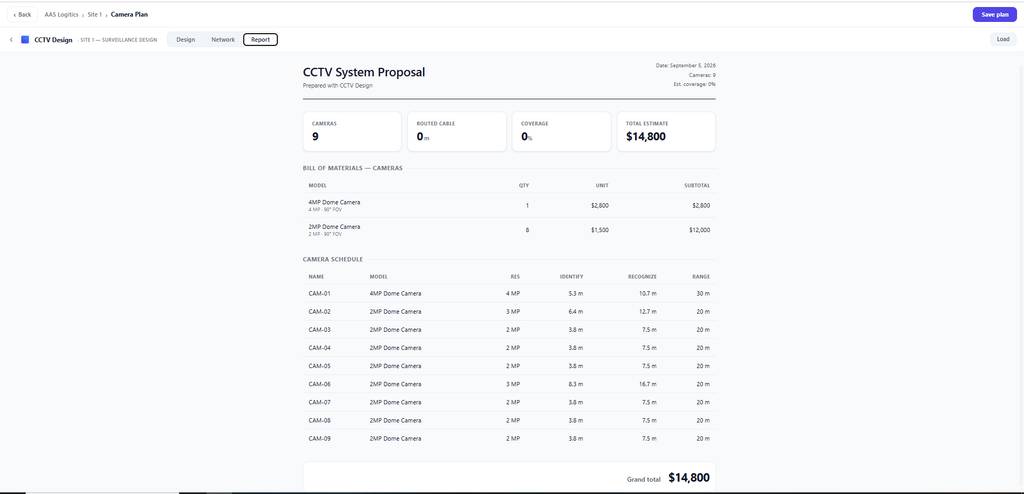
Share a Professional CCTV Proposal
A visual camera plan combined with an itemized quotation gives customers a clearer picture of the complete solution.
They can see where you will install the cameras, what areas they will cover, what equipment they need, and how you calculate the total cost.
Instead of sending separate PDFs, Excel sheets, screenshots, or long WhatsApp messages, your team can share an interactive proposal.
Customers can explore the camera layout, coverage areas, equipment details, Bill of Materials, camera specifications, and pricing from one place.
This creates a more professional sales experience and reduces confusion between what was discussed and what is included in the final proposal.
Read more: Share the Camera Plan and Quotation With Your Customer Directly
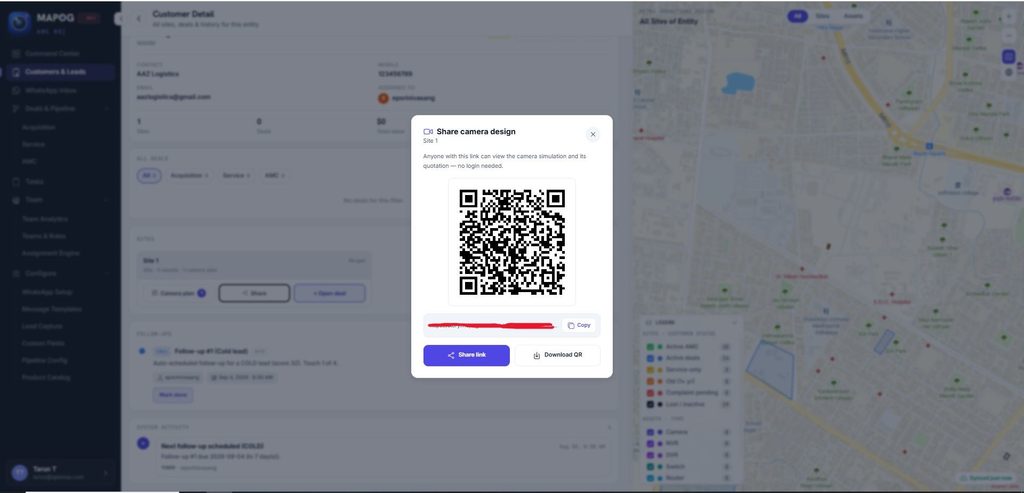
Make the CCTV Sales Process More Efficient
Preparing a camera layout and quotation manually can involve several separate steps.
The sales team may need to design the floor plan, mark camera locations, calculate equipment quantities, prepare the Bill of Materials, calculate pricing, and update the quotation whenever the customer requests a change.
MAPOG brings these important steps into one connected workflow.
Your team can move from camera planning to CCTV design, coverage review, equipment selection, and quotation generation without relying entirely on separate tools.
This saves time, reduces manual calculations, and makes it easier to respond when customers request changes to the proposed system.
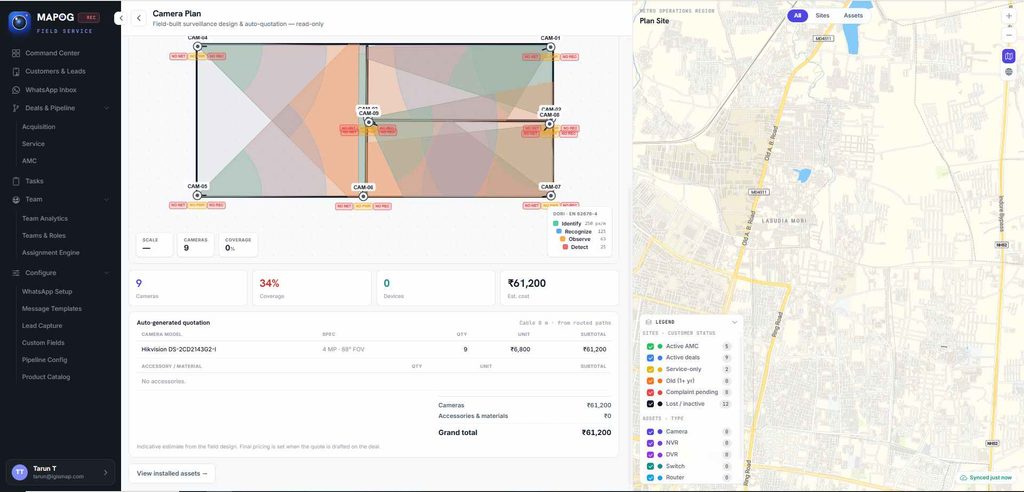
The Business Impact of Better CCTV Planning with CCTV Camera Planning Software and Quotations
Winning new CCTV projects is important, but a clear and professional proposal can make the sales process more effective.
A well-planned camera layout helps customers understand the proposed security solution, while a connected quotation shows exactly what equipment they need and how you calculate the total cost.
With MAPOG, CCTV companies can design camera layouts, check coverage, identify potential blind spots, add equipment, generate quotations, and keep pricing aligned when the design changes.
Because successful CCTV businesses don’t just install cameras.
They plan smarter, design clearly, quote accurately, and give customers a complete view of the solution before installation begins.
Book a free demo of MAPOG and see how you can simplify CCTV camera planning, design, and quotation generation.
Here are some other blogs you might be interested in: